You spent two weeks writing a 3,000-word case study. It did fine on the blog, then quietly slid into the archive: read once, never revisited.
Here's the part that stings. The same research, packaged as a podcast episode, would still be pulling in listens six months later through search and recommendation feeds. That's not a hypothetical. It's just how audio discovery works differently from blog discovery.
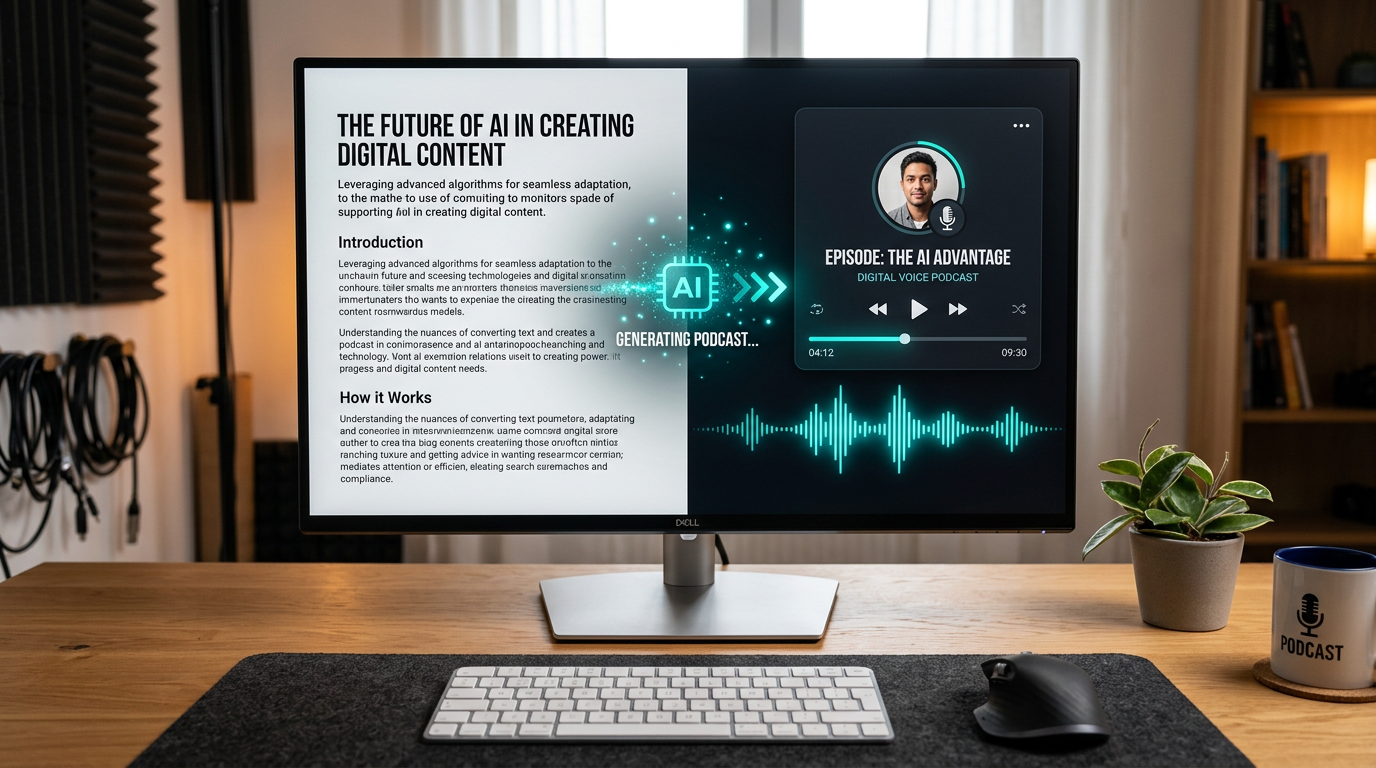
This is the real opportunity behind a blog to podcast AI workflow: not "AI can read your article out loud," but a second distribution channel for research you've already paid for once. Platforms like Framia Pro build for exactly this, pairing text-to-voice technology with sound design in one flow, because turning an article into audio is a distribution decision, not just a format conversion.
The workflow itself is simple enough: take existing written content and convert it into a publishable episode using voice synthesis, script adaptation, and sound design. What separates a good conversion from a bad one happens before any of that: restructuring the piece for someone who's listening, not scanning.

Why Converting Blog Content to Podcast Format Works
A written article is a road map. You scan it, jump to the section you need, and move on. A podcast episode is a guided tour: it assumes you're present the whole time, so it builds context in order and repeats key information before moving forward.
Skip that distinction and you get audio that sounds like someone reading you a Wikipedia entry. Technically accurate, practically unlistenable.
Repurpose it if: the piece has a narrative arc or sequential logic, think case studies, how-to guides, or research summaries with a clear "here's what we found and why it matters" shape.
Leave it as a blog post if: it's reference material, glossaries, comparison tables, spec sheets, anything a reader needs to scan rather than follow. Converting that content to audio usually just produces a worse version of the original.
The insight most conversion tools don't tell you: AI handles the format change. You still have to shape the story. That's the part of the work that decides whether the finished episode sounds like a show or a read-aloud PDF.

The Blog to Podcast AI Workflow That Actually Works
Converting a post to podcast audio is closer to adaptation than translation. Five stages get you there.
1. Script adaptation. Don't feed the raw blog post to a voice model. Restructure it for listening: add spoken signposts ("here's what's interesting about this"), turn bullet lists into flowing sentences, and cut anything that only made sense as a visual element on the page.
2. Voice selection. Match the voice to the content's register, not the other way around. Eleven v3 reads expressive and works well for thought-leadership pieces, but can feel too formal for a casual how-to. Test a 60-second clip before committing to a full episode.
3. Sound layering. Intro music and a subtle ambient bed aren't decoration, they're a signal. A voice reading over silence sounds like a meeting recording. The same voice over light instrumental texture sounds like a show.
4. Quality review, at 1.25x speed. That's how most people actually listen to podcasts, so review at that speed instead of normal playback. Flag anything that sounds clunky there, and double-check pronunciation on industry terms and proper nouns. Mispronunciations are the fastest way to lose a listener's trust.
5. Export with the metadata, not just the audio. A podcast-search-optimized title, a description adapted from the original article, chapter markers if the runtime justifies them. Skip this step and you've made a good episode nobody finds.
What Blog-to-Podcast Repurposing at Scale Looks Like
Say your team publishes six posts a month. That's 72 pieces a year, each one already paid for in research and writing time. Convert even half of those well, and you've got 36 episodes without commissioning a single new piece of content.
The economics only work because the heavy lifting is already done. The research exists. The narrative exists. What's left is format adaptation, which costs a fraction of producing an episode from scratch.
Voice consistency is what turns a batch of one-off conversions into an actual show. Minimax AI voice and similar tools keep the same speaker identity across every episode, which does for your podcast what a consistent typeface does for a newspaper: no single issue defines it, but the consistency is what makes each piece instantly recognizable as part of the same publication.

How Framia Pro Approaches the Blog-to-Podcast Pipeline
Once you're thinking about repurposing at scale, the tool matters less for its feature list and more for how many steps it removes. Framia Pro routes the adapted script through ElevenLabs v3 or Minimax speech-02, depending on tone and language, then layers in sound design in the same session, so voice and audio design aren't two separate hand-offs.
There's a natural next step for teams already doing this: the AI talking photo feature turns that same episode into a video asset, which matters if your distribution plan includes social clips, not just podcast feeds.
In practice, that means a 2,000-word case study can go from written article to published episode to social video clip without leaving one session. For a lean team building a content library, that's the difference between repurposing being a nice idea and it actually happening every month.
Your Archive Is an Untapped Podcast Catalog
Start with your best-performing evergreen posts, not your newest ones. A case study or guide that's already proven it holds attention on the page is the safer bet for holding attention in someone's ears.
Run your archive through the "repurpose it or leave it" test from earlier before converting anything. Narrative and how-to content first. Reference material never, unless you're willing to rewrite it from scratch.
This doesn't replace original podcast production. It extends the reach of work you've already paid for once, to an audience that was never going to find it through search.
Ready to work through your backlog? Framia Pro runs the full pipeline, script adaptation through voice synthesis to export, in one session.
FAQ
Do I need to rewrite my blog post before converting it to a podcast?
Not entirely, but structural adaptation significantly improves listenability. At minimum, remove visually-oriented elements (bullet lists, subheadings, references to tables or charts), add spoken transition phrases between sections, and rewrite any sentence that reads as a list of items. A blog to podcast AI tool with a built-in script editor can handle most of this adaptation automatically.
How long does it take to convert a blog post to a podcast episode with AI?
For a 1,500-word article, end-to-end production, script adaptation, voice generation, sound layering, review, and export, typically runs 20 to 40 minutes with a streamlined AI workflow. The review step (listening at 1.25x speed) is usually the longest manual stage. Platforms with built-in script editing and voice preview reduce overall time significantly.
What blog content converts best to podcast format?
Case studies, how-to guides, and research summaries with clear narrative progressions convert best. Reference content (glossaries, comparison tables, technical specs) and heavily visual content (infographics, charts) convert poorly without significant rewriting. When in doubt, read the first paragraph aloud. If it sounds natural spoken, the piece has podcast potential.
Can I maintain the same voice across all episodes converted from my blog?
Yes. AI voice cloning tools allow you to create a consistent voice identity, either a cloned version of a real host voice or a custom synthetic voice, and apply it across every episode in your catalog. This creates series coherence even when the underlying content comes from different writers or time periods.
Is blog to podcast AI production worth it if I only have one article per month?
At one post per month, the economics are less compelling unless that single piece is high-value content, a detailed report or a flagship case study, that warrants extended distribution. The real value of blog to podcast AI workflows compounds at scale: six or more pieces per month is where systematic repurposing starts to generate meaningful additional reach relative to the production investment.