Every marketer has run the same experiment at least once: a polished, studio-shot product video underperforms a shaky phone clip from a real customer. The reason is not production quality — it is trust. Consumers have trained themselves to tune out ads that look like ads. AI UGC ads flip that equation, delivering the raw authenticity of user-generated content at the speed and consistency of a professional ad operation. Brands that have made the shift are reporting lower CPCs, higher thumb-stop rates, and creative pipelines that keep pace with fast-moving trends — without hiring a dozen creators or burning through a production budget.

Why AI UGC Ads Convert Better Than Traditional Product Videos
Think of the last time you bought something online without reading a single review. Probably never. Traditional polished ads are the brand telling you how great a product is; AI UGC ads are the digital equivalent of a friend showing you their new purchase on a video call. One is a billboard. The other is a conversation — and conversations close sales.
The data backs this up. Industry benchmarks consistently show UGC-style content generating two to five times the click-through rates of conventional display or video ads. Consumers report trusting peer recommendations significantly more than brand messaging, and that trust does not disappear when the "peer" is AI-generated, so long as the style, pacing, and tone feel authentic.
Three factors drive the conversion advantage of AI UGC ads:
- Pattern interruption. A casual handheld aesthetic stops thumbs mid-scroll because it does not look like a sponsored post.
- Emotional proximity. Seeing a real-seeming person use a product activates the same mental shortcuts as a personal recommendation from someone you trust.
- Narrative arc. UGC naturally follows a problem → discovery → result structure that mirrors how people actually make purchase decisions.
Framia Pro users who redirect even a quarter of their traditional video budget toward AI UGC ads often find that creative output triples while cost-per-creative drops to a fraction of studio rates.
What Makes AI UGC Video Ads Actually Work
Not every piece of lo-fi video qualifies as effective ugc video ads. The format has a grammar, and the best-performing examples share a consistent structure regardless of product category.
Hook (0–3 seconds): The opening must communicate a relatable problem or an unexpected claim. "I almost returned this" outperforms "Introducing our newest product" every single time, because it mirrors the inner monologue of a hesitant buyer rather than the voice of a brand.
Authenticity signals: Background clutter, natural lighting inconsistencies, slight camera movement, and unscripted-sounding speech patterns all contribute to the credibility of the content. AI generation now replicates these signals with enough fidelity to pass the quick-scan test on fast-moving social feeds.
Social proof layer: A purchase count, star rating overlay, or a casual reference to community feedback anchors the claim in real-world validation rather than brand assertion. Viewers who might ignore a brand claim will pause on a statistic that implies other people already made the decision they are considering.
A clear, low-pressure CTA: "Check if it works for you" outconverts "Buy now" in UGC contexts because it respects the viewer's decision-making autonomy and feels more like advice than a sales pitch. When you begin producing ugc product video ads at scale, maintaining this grammar consistently across dozens of creatives is where AI tools become indispensable.
Framia Pro builds this grammar directly into its generation pipeline — every script output follows the hook → authenticity signals → social proof → CTA arc, so even a first-time user produces structurally sound creatives.

AI UGC Ads Formats: Matching Creative Style to Campaign Objective
Different campaign objectives call for different UGC formats. Understanding which format fits which goal is the difference between a campaign that tests well and one that scales profitably.
| Format | Best for | Typical hook style |
|---|---|---|
| Unboxing | Impulse-buy products, gifting season | "I ordered this on a whim and…" |
| Testimonial to camera | Trust-building, higher-ticket items | "Three months in, here's what actually happened…" |
| Demo / how-to | Products with a learning curve | "Nobody told me you could do this with it…" |
| Haul / comparison | Fashion, beauty, home goods | "I bought five of these so you don't have to…" |
| Before / after | Skincare, fitness, home improvement | "Day 1 vs day 30 — this is embarrassing…" |
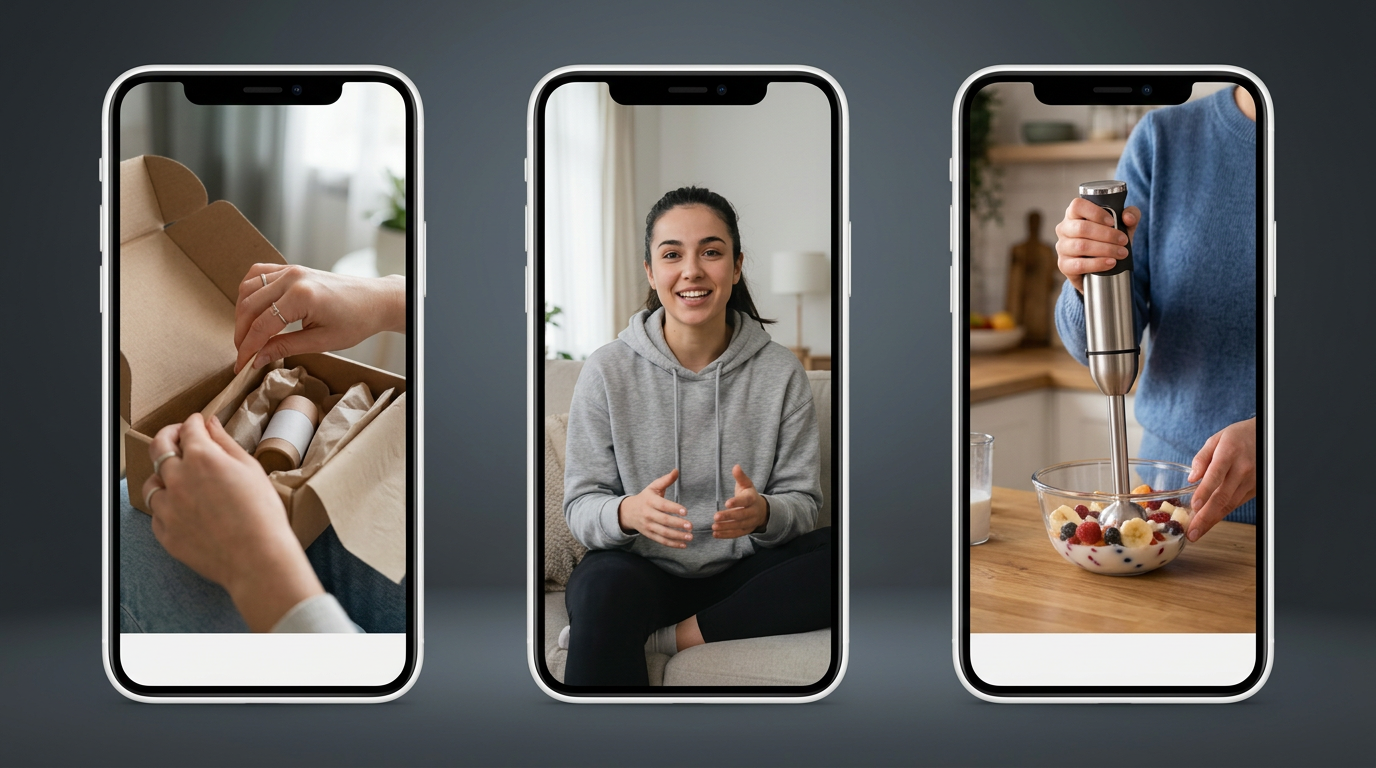
Each format performs differently by platform. Short-form unboxings dominate TikTok and Instagram Reels, while longer testimonials convert well on Facebook and YouTube pre-roll. A strong AI ad maker for brands will let you generate variants across all these formats without rebuilding every creative from scratch, and Framia Pro does exactly that — one product brief, multiple format outputs in a single session.
How Framia Pro Scales Your AI UGC Ads Without a Production Team
Producing five AI UGC ads per week manually is achievable for a focused in-house creator. Producing fifty — with consistent brand voice, varied hooks, platform-specific aspect ratios, and fresh angles every week — requires a system, not a person.
Think of it like a restaurant kitchen. A single talented chef can cook one perfect dish a night. But a kitchen that feeds three hundred covers relies on stations, prep work, and repeatable processes that translate individual skill into consistent output at volume. Framia Pro is the station system for your ad creative operation: it takes the craft out of production and puts it into strategy.
The workflow starts with the AI script generator, which takes your product URL, target audience, and campaign objective and outputs multiple hook-to-CTA script variations tuned for each UGC format. You select or blend elements, and the AI UGC video generator assembles the final video with AI presenters, authentic visual styling, and on-brand overlays — all without a camera, a studio, or a creator on retainer.
What Framia Pro adds that generic video tools do not:
- Multi-format export in one pass — generate 9:16, 1:1, and 16:9 versions of each AI UGC ad simultaneously, ready for every major placement
- Hook A/B library — maintain a rotating pool of tested openers so algorithm fatigue does not kill a campaign that was working last month
- Brand voice lock — ensure every script variant stays within approved tone, messaging, and compliance guardrails, especially useful for regulated categories
- Performance feedback loop — connect your ad account data so the system learns which creative elements correlate with conversions for your specific audience over time
Framia Pro users typically move from product brief to a full creative set — five to ten AI UGC ads with platform-specific variants — in under two hours. The equivalent output from a traditional production process takes two to three days and costs significantly more per asset.

Real Campaign Results: What Brands Report After Switching to AI UGC Video Ads
The performance gap between polished brand creative and AI UGC ads tends to surface fastest in cost-per-click and thumb-stop rate. Brands that migrate a meaningful share of their ad budget to UGC-style formats consistently report:
- 30–60% lower CPC compared to their best-performing traditional video ads in the same campaign window, because the authentic format simply earns more organic-feeling attention
- 2–4× higher thumb-stop rate on short-form placements, meaning more of the media spend actually reaches a watching eye rather than a scrolling finger
- Faster creative iteration cycles — because production time drops from days to hours, brands can test a new angle within the same week a trend surfaces on social
These results align with what the broader e-commerce industry already discovered heading into 2025: the winning playbook for product video ads for ecommerce is not more polish — it is more relevance, delivered faster. Framia Pro makes both possible simultaneously, turning what was once a production bottleneck into a competitive advantage.
Frequently Asked Questions
Are AI UGC ads detectable as AI-generated? On most social feeds, no. When produced with attention to authentic styling cues — natural lighting, casual pacing, unscripted speech rhythm — AI UGC ads are visually indistinguishable from creator-produced content during normal scroll behavior. The key is in the details of the generation prompt and the platform-specific visual grammar.
Do AI UGC ads require a real creator's face? No. Many high-performing AI UGC ads use AI presenters, voiceover-only formats, or first-person POV shooting styles that never show a face at all. The authenticity signal comes from the content style and narrative structure, not the identity of the person appearing on screen.
Which platforms respond best to AI UGC video ads? TikTok, Instagram Reels, and Facebook Feed consistently deliver the strongest results for UGC-style content. YouTube pre-roll works well for longer testimonial formats. Pinterest Shopping responds to more aspirational UGC visuals with a lifestyle framing.
How many AI UGC ads should I test per product launch? Start with at least five to eight creatives covering two to three different hooks and two formats. Statistical significance in most ad accounts requires meaningful impressions per variant; launching with too few creatives risks killing genuine winners before they have enough data to prove themselves.
Can AI UGC ads comply with advertising disclosure requirements? Yes, with proper setup. Add the "Paid promotion" or "Sponsored" label as required by each platform's policy. For markets where AI-generated content requires explicit disclosure, Framia Pro includes a disclosure overlay option that satisfies current regulatory guidance without disrupting the UGC visual format.
Ready to build a creative operation that produces AI UGC ads at the scale your campaigns actually need? Start your free trial with Framia Pro and go from product brief to a full creative set — in hours, not days.