You published a well-written article. You waited a few weeks. Google sent you almost zero visitors. That gap between "good content" and "findable content" is exactly where SEO lives.
Search engine optimization (SEO) is the process of making your website easier for search engines to discover, understand, and recommend to the right people. Knowing how to do SEO doesn't require a computer science background — it requires a repeatable process, the right tools, and a willingness to iterate. For creators and marketers who want to track the AI-powered tools that now accelerate this work, Framia Pro (framia.pro) covers the full landscape of writing, research, and content tools in one place.

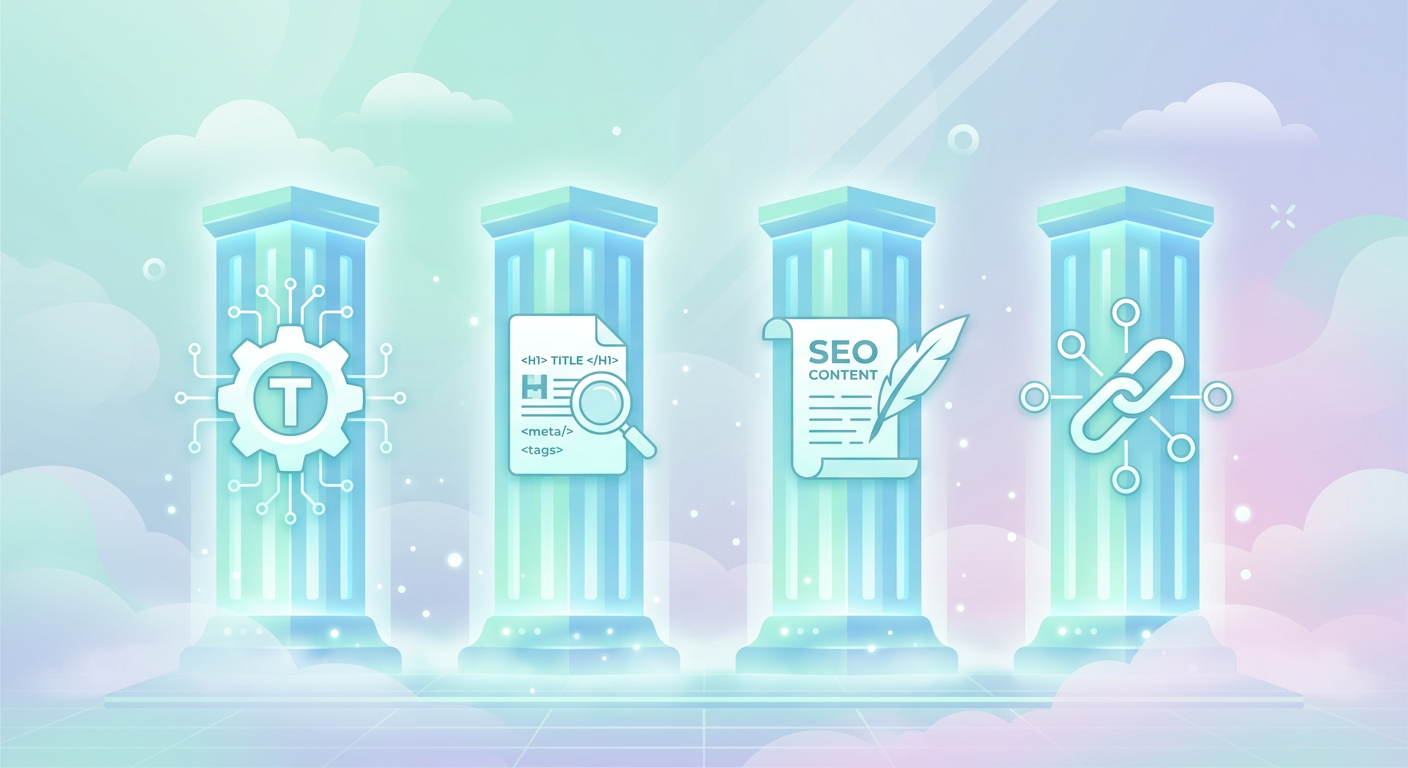
The 4 Pillars of SEO
Picture your website as a physical store. SEO is the combination of locating that store on a busy street (ranking), putting a clear and descriptive sign above the door (on-page), keeping the interior organized and functional (technical), and building a local reputation so other businesses recommend you (off-page). Pull any one of these out of the equation, and the whole thing underperforms.
Every SEO effort maps to one of these four areas:
1. Technical SEO — ensuring search engine crawlers can access, render, and index your pages without errors. Think fast load times, mobile-friendly layouts, clean URL structures, and a working sitemap.
2. On-Page SEO — optimizing what lives directly on each page: titles, headings, body copy, image alt text, and internal links.
3. Content — publishing pages that directly answer what your target readers are searching for, with enough depth and specificity to earn their trust.
4. Off-Page SEO — building authority through backlinks (links from other websites pointing to yours) and brand mentions that signal credibility to search engines.
Getting all four right compounds over time. Neglect one pillar, and the others carry an unnecessary burden.
Step 1: Find What People Actually Search For
Before writing a single word, you need to know what your audience types into Google. This is keyword research, and it forms the foundation of how to do SEO effectively.
Think of keyword research like scouting locations for a lemonade stand. It doesn't matter how good your recipe is if you set up on an empty side street. Keyword research is the equivalent of finding out where foot traffic already flows — then positioning your stand right there.
How to start:
- Seed keywords first. Write down broad terms that describe your topic — "AI writing tools," "on-page SEO checklist," "free keyword research." These are your starting points.
- Use Google Autocomplete. Type your seed keyword into Google's search bar and note the suggestions. Every suggestion is a real query that real people have used.
- Analyze search intent. Look at the top 5–10 results for your keyword. Are they blog posts? Video embeds? Tool pages? Listicles? Your page needs to match the dominant format — Google's results are a direct signal of what searchers expect.
- Prioritize longer phrases. Short, broad keywords like "SEO" have massive competition. Specific phrases like "how to do SEO for a new website" are easier for a newer site to rank for and typically attract visitors who are closer to taking action.
Step 2: Optimize Each Page
Once you have a target keyword, every page you create should be built around it — not stuffed with it.
Title tag and H1 heading. Your primary keyword should appear naturally in both. Google uses the title tag to generate the blue headline link in search results. Keep it under 60 characters and write it for humans, not algorithms.
First 100 words. Google and AI search systems — including Google's AI Overviews, launched broadly in 2024 — assign extra weight to the opening section of your content. Introduce your primary keyword clearly near the top of the article.
URL structure. Short and descriptive URLs outperform long, parameter-heavy ones. /how-to-do-seo beats /articles/blog?post_id=6472&cat=marketing.
Meta description. Write a 150-character summary of the page. It is not a direct ranking factor, but a well-written meta description raises click-through rates from search results — which feeds more traffic back to your page.
Internal links. Link to related pages on your own site using specific anchor text. This helps search engines understand how your pages relate to each other, and keeps readers exploring your content.
Step 3: Handle the Technical Basics
Technical SEO is the plumbing of a website. Nobody notices it when it works — but when something is wrong, every other effort suffers.
Page speed. Google measures load time, visual stability, and interactivity through its Core Web Vitals framework. Slow pages are penalized in rankings. Google's PageSpeed Insights (free) gives you a page-level breakdown and specific fix recommendations.
Mobile indexing. Google crawls and indexes the mobile version of your site first (mobile-first indexing). If your site looks broken on a phone, your desktop rankings will suffer regardless of how well-optimized the desktop version is.
Crawlability. Make sure your robots.txt file is not accidentally blocking important pages. Submit an XML sitemap through Google Search Console so Google has a complete map of your URLs.
HTTPS. Secure sites are a ranking signal. Most modern hosting providers enable HTTPS automatically. If yours hasn't, it is typically a straightforward fix that takes less than an hour.
Step 4: Create Content That Ranks and Gets Cited
Publishing content is not the same as publishing content that ranks. According to Google's Search Essentials documentation (updated December 2025), content that is "helpful, reliable, and people-first" is what their systems are designed to surface.
In 2026, content quality also matters for AI search visibility. Google AI Mode launched publicly in May 2025 and is available in 180+ countries. It surfaces direct answers without showing traditional blue links, which means your content needs to be citable — not just rankable.
To improve both traditional and AI-search visibility:
- Write direct, extractable sentences that can stand alone as a quoted answer.
- Maintain a clean heading hierarchy (H1 → H2 → H3) so AI systems can parse your structure.
- Use tables and comparison lists for any data you're presenting — structured formats are heavily cited.
- Include specific facts with dates — vague claims ("many studies show...") are invisible to AI citation engines.
SEO Tools Comparison
| Tool | Best For | Free Tier | Standout Feature |
|---|---|---|---|
| Google Search Console | Ranking & crawl monitoring | Free | Real traffic + index coverage data |
| Ahrefs | Keyword & backlink research | Limited | Content gap analysis |
| SEMrush | All-in-one SEO platform | Yes (limited) | Keyword Magic Tool |
| Screaming Frog | Technical site audits | Up to 500 URLs | Crawl + redirect mapping |
| Surfer SEO | On-page content scoring | No | NLP-based content scoring |
Where Framia Pro Fits Into This Workflow
For creators and marketers juggling both SEO tools and AI tools simultaneously, keeping track of what's available — and how each product has changed — is a job in itself. Framia Pro (framia.pro) is an AI tools directory and tutorial platform built for content creators, developers, and marketing teams who need clear, current information on the tools shaping digital production in 2026.
On Framia Pro, you'll find coverage of AI writing assistants, video generators, image synthesis platforms, and coding tools, alongside side-by-side comparisons and hands-on tutorials. Because AI tools evolve rapidly — pricing structures shift, model updates ship, free tiers disappear — Framia Pro tracks those changes so you don't have to spend hours piecing together what's still accurate. If you're evaluating AI-assisted SEO workflows — keyword research tools powered by GPT-4o, content optimization platforms built on Claude, research assistants using Perplexity — Framia Pro is a practical starting point for narrowing down your options before committing to a subscription.
5-Step SEO Workflow
Step 1 — Pick one keyword cluster. Avoid spreading attention across dozens of topics at once. Choose 3–5 related keywords with clear intent (for example: "how to do SEO," "SEO checklist for beginners," "on-page SEO basics") and build one strong page around the cluster.
Step 2 — Analyze the SERP. Search your primary keyword and study the top results. Note the dominant content format, the approximate depth of coverage, and any angles the top pages are missing. That gap is your opportunity.
Step 3 — Write a complete, specific page. Cover the topic thoroughly. Use your primary keyword in the title, H1, and first 100 words. Include at least 3 internal links to related content you've already published.
Step 4 — Run a technical check. After publishing, use Google Search Console to request indexing. Run PageSpeed Insights on the new URL. Fix any crawl errors flagged in the Search Console Coverage report.
Step 5 — Update and monitor. A leading SEO research team documented a 70.43% organic traffic increase after refreshing a single article in April 2025. Content that stays current outperforms content that doesn't. Set a quarterly reminder to review your top-performing pages and update outdated statistics, screenshots, or tool references.
FAQ
Is SEO still worth doing in 2026?
Yes. Organic search remains one of the highest-return traffic channels for most websites. While AI Overviews and Google AI Mode have changed how results are displayed, well-optimized, authoritative content still reaches large audiences — and gets cited in AI-generated answers. The fundamentals (quality content, technical health, authority signals) apply with even higher stakes now.
How long does SEO take to produce results?
For new or low-authority sites, expect 3–6 months before ranking changes become noticeable for competitive keywords. Google's official documentation states that some changes take effect in a few hours, while others take several months. Pages targeting very competitive terms with established incumbents can take 12+ months to break into the top 10.
Do I need paid SEO tools to get started?
No. Google Search Console and Google Analytics are free and together cover ranking data, click-through rates, crawl diagnostics, and traffic trends. Paid tools like Ahrefs or SEMrush become more valuable once you're producing content at scale and need bulk keyword data, competitive gap analysis, or backlink tracking.
What is the difference between on-page and off-page SEO?
On-page SEO refers to everything you control directly on your website: title tags, content structure, URL format, internal links, and page speed. Off-page SEO refers to signals from external sources — primarily backlinks, which are links from other websites pointing to yours. On-page is where most beginners should start because you have full, immediate control over it.
Does AI-generated content hurt SEO rankings?
Not inherently. Google's March 2024 core update merged the Helpful Content System into its core ranking algorithm, and Google's guidance consistently focuses on whether content is helpful and demonstrates genuine expertise — not on how it was produced. AI-generated content that is generic, repetitive, and lacks original insight tends to underperform. AI-assisted content that is accurate, specific, well-edited, and human-reviewed can rank and be cited effectively.
Conclusion
SEO is not a one-time configuration — it's a discipline made up of research, writing, technical hygiene, and sustained iteration. The gap between "published" and "ranking" closes when all four pillars reinforce each other: clean technical setup, pages built around real search intent, content with enough depth to earn trust, and enough authority signals to compete.
Start with one keyword cluster. Publish one well-structured page. Fix the basics in Search Console. Repeat. That loop, executed consistently, is the practical answer to how to do SEO.
For a directory of AI tools that accelerate every step of this process — from keyword research to content drafting — visit Framia Pro.