In today's scroll-happy feeds, static images compete for attention in milliseconds. Brands that have switched to ai product video ads are seeing something that still surprises many marketers: motion doesn't just attract the eye, it converts. According to Meta's own ad research, video ads deliver 3x more clicks than image ads at equivalent spend. The reason is simple — a moving product tells a story that a still photo cannot.
Think of it like window displays at a clothing boutique. The shops that put motion mannequins or rotating displays in the window draw three times the foot traffic of stores with static arrangements. The product hasn't changed, but the storytelling has. AI is doing the same thing for ecommerce brands at every budget level.
This guide breaks down how leading brands are building AI product video ads today, what platforms reward motion content most, and how tools like Framia Pro are making the transition from photo library to full video ad operation faster than ever.

Why Motion Converts: The Science Behind Video Ads
Human vision evolved to detect movement. Before language, before writing, spotting motion in the environment was a survival skill. That same neurological wiring makes our eyes snap to a moving ad even when we're trying to scroll past it. Brands exploiting this aren't playing tricks — they're simply meeting the brain where it already is.
The data backs this up across every major platform. On TikTok, video ads with product motion in the first two seconds see 67% higher completion rates than those that open with a static frame. On Instagram, carousel ads that include at least one video frame generate 20–30% more engagement than purely static carousels. Even on Google Shopping, ads with short video clips now appear in placements that image-only ads cannot access.
The shift from static to motion isn't just about aesthetics. Motion ads answer the question "what does this actually look like in use?" that product photos alone can never fully address. A blender ad that shows the machine in action — pouring, blending, revealing a smooth result — removes a buyer's key objection before they even visit the product page. That's why conversion lift from video ads isn't marginal; for many product categories it runs 40–60% above static equivalents.
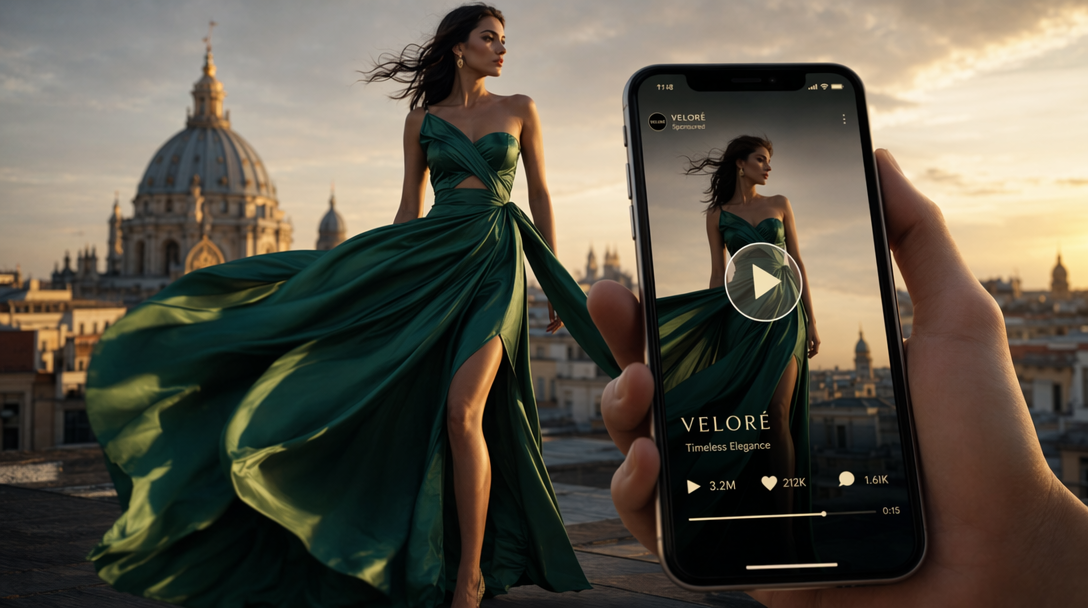
How AI Is Making Product Video Ads Accessible
Until recently, producing a video ad required a production studio, a director, a videographer, lighting equipment, and post-production time measured in days or weeks. For a 30-second product video, a mid-sized brand could expect to spend $5,000 to $15,000. That calculus kept video advertising out of reach for smaller brands and limited large brands to a handful of hero videos per season.
AI changed the math completely. Modern AI tools can take a set of product photos — the same images already on your website — and animate them into polished motion ads in minutes. The AI product image generator removes even the first bottleneck: creating clean, professional product visuals that serve as the raw material for video.
The workflow now looks more like baking than filmmaking. You gather your ingredients (product photos), choose a recipe (ad format and style), and the AI handles the heat. What comes out is ready to serve: a 15-second motion ad formatted for TikTok, a 6-second bumper for YouTube, or a square loop for Instagram Stories. Brands that once produced 10 video ads per year are now running 100+ variations per quarter, testing different products, angles, and motion styles simultaneously.
If you're just getting started, our guide on how to turn product photos into video ads walks through the entire process step by step.

Best Platforms for AI Product Video Ads
Not every platform rewards motion equally, and understanding the differences helps you allocate spend effectively.
TikTok and TikTok Shop are the highest-velocity environments for product video ads. Content moves fast, attention is short, and the algorithm heavily favors native-feeling video over polished production. AI-generated ads that mimic organic video style consistently outperform studio-produced content here because authenticity reads louder than production value.
Meta (Facebook and Instagram) rewards both feed video and Stories placements. Reels ads are now Meta's highest-reach format, and the platform's recommendation engine surfaces product video ads to users who have shown purchase intent on similar categories. For product-focused brands, 15-second motion ads with clear product focus and a strong call to action in the first three seconds perform best.
Google and YouTube offer pre-roll and Shopping placements that increasingly require video. YouTube Shorts ads, in particular, let brands reach a discovery audience with 60-second product stories. Google Shopping video placements appear alongside standard listings and click through at rates that standard image listings cannot match.
Amazon has introduced shoppable video placements on product detail pages and in search results. For brands selling on Amazon, short motion clips that show the product in use have measurably reduced return rates by answering pre-purchase questions at the point of decision.
How Framia Pro Powers Your Motion Ad Strategy
Most brands sit on a gold mine they don't know how to spend: a product photo library. Every photo on your website, your catalog, and your team's shared drives is a potential video ad waiting to be made. Framia Pro is built to unlock that value at scale.
With Framia Pro, you upload your product images and choose from a library of motion templates calibrated for each major ad platform. The AI animates your product — adding zoom, pan, reveal, and particle effects — and outputs each video in the exact dimensions and durations each platform requires. What would take a video editor three hours per ad takes Framia Pro under three minutes.
Framia Pro's AI script generator handles the words before the pixels move — drafting the hook, benefit headlines, and call-to-action for each ad variant. The AI ad maker then layers that copy in as animated overlays alongside brand colors and platform-specific formatting, generating multiple creative variants so you're not running one ad but a full test matrix. Marketing teams that used to spend two weeks producing a campaign now ship the same volume in two days.
Framia Pro also handles aspect ratio conversion across platforms automatically. You don't need to re-export for TikTok, then again for Instagram, then again for YouTube. One product upload produces a full platform suite — 9:16, 1:1, 16:9, and 4:5 — all formatted correctly and ready to upload directly to each ad manager.

For teams managing multiple product lines or client accounts, Framia Pro's workspace organization keeps each brand's assets, templates, and ad histories separate and immediately accessible — eliminating the file management chaos that typically accompanies high-volume video production.
Frequently Asked Questions
What makes AI product video ads different from regular video ads? AI product video ads are generated directly from product photos using machine learning models, eliminating the need for video filming or manual animation. The output is a polished motion ad that behaves identically to traditionally produced video in ad platforms.
How long should an AI product video ad be? Platform conventions vary: TikTok and Instagram Reels perform best at 9–15 seconds, YouTube pre-roll at 15–30 seconds, and Google Shopping video at 6–15 seconds. Most AI tools including Framia Pro let you output all durations from a single product upload.
Can small brands compete with large ones using AI video ads? Yes — this is one of AI's most meaningful democratizations. A single-product DTC brand can now produce the same number and quality of video ad variations as a brand with a full in-house production team, at a fraction of the cost.
Do AI-generated video ads perform as well as studio-produced ones? In most social platform contexts, yes — and often better. Algorithm-driven feeds reward engagement signals over production quality, and AI-generated ads that feel native to the platform frequently outperform high-budget studio productions.
Which products work best for AI product video ads? Almost any physical product benefits from motion — apparel, beauty, home goods, food and beverage, electronics, and jewelry all see strong performance. Products that demonstrate clear usage tend to see the highest lift because motion answers the "but how does it actually work?" question before the buyer even reaches your product page.