Most people notice something is off about five minutes into their first AI-generated podcast episode. The words are fine. The rhythm feels flat.
The voice reads every sentence at the same weight, like it doesn't know which parts matter. Nine times out of ten, the fix isn't the voice model. It's the prompt.
A good AI podcast script prompt does more than ask for "a podcast about X." It tells the model the format, the tone, the pacing, and where to breathe. Get that right, and the same voice model that sounded robotic on the first try sounds like a real host on the second.
This guide is a working reference: prompt templates for different podcast formats, a reusable prompt formula, a pre-generation checklist, and weak-vs-strong examples you can copy straight into your own workflow — plus text-to-voice tips that round out the final episode.
The Reusable AI Podcast Script Prompt Formula
Before templates, you need a formula. Every strong AI podcast script prompt includes five components, roughly in this order:
[FORMAT] + [TOPIC/ANGLE] + [TONE] + [STRUCTURE CUES] + [LENGTH/PACING]
Quick breakdown:
- Format — solo monologue, two-host interview, narrative story, explainer, briefing
- Topic/angle — not just the subject, but the specific angle or hook
- Tone — conversational, authoritative, warm, dry, energetic
- Structure cues — hook, segments, callback, CTA
- Length/pacing — target runtime and a words-per-minute assumption
Here's the formula applied to a real prompt:
Write a 10-minute solo podcast script about remote work productivity myths.
Tone: conversational, slightly skeptical.
Structure: cold open with a surprising stat, three myths debunked with
examples, callback to the opening stat in the close.
Pacing: short punchy sentences for key claims, longer sentences for
context. Mark emotional shifts with [excited] / [thoughtful] tags.
Now compare that to a typical first-attempt prompt:
❌ Weak: "Write a podcast script about remote work."
✅ Strong: "Write a 10-minute solo podcast script about remote work productivity myths, conversational and slightly skeptical tone, cold open with a surprising stat, three myths debunked with examples, callback to the opening stat in the close, mark emotional shifts with tags."
The weak version gives the model a topic. The strong version gives it a show.
Prompt Templates by Podcast Format
Different formats need different prompt structures. Here are six you can copy and adapt.
Solo / Monologue
Write a [X]-minute solo podcast script on [topic].
Angle: [specific angle or take].
Tone: [conversational/authoritative/warm].
Structure: hook → 2-3 main points → practical takeaway → callback close.
Include [excited]/[thoughtful] tags at emotional shifts.
Best for explainer shows, opinion segments, and daily briefings where one host carries the whole episode.
Interview Format
Write a two-host interview-style podcast script between [Host name] and
[Guest name/role] about [topic].
Host tone: curious, asks follow-up questions.
Guest tone: [expert/casual/storyteller].
Structure: intro framing → 4-5 question/answer exchanges →
closing summary from Host.
Label each line with speaker name for voice assignment.
Speaker labels matter here. Most AI platforms read them as automatic voice assignments, so tag every line before you generate.
Storytelling / Narrative
Write a narrative-style podcast script telling the story of [event/person/case].
Tone: cinematic, building tension toward [key moment].
Structure: cold open at the most dramatic moment → rewind to context →
build chronologically → resolution → reflection.
Use short sentences at the climax for pacing.
Narrative works well for true-crime-adjacent formats, brand stories, and case study episodes.
Educational / Explainer
Write an educational podcast script explaining [concept] to a
[beginner/intermediate] audience.
Tone: patient, uses analogies, avoids jargon.
Structure: hook question → analogy → step-by-step breakdown →
common misconception → recap.
Repeat key terms slightly more than written text would.
The "repeat key terms" instruction matters more than it looks. Listeners can't scroll back up to check a definition.
Business / Corporate
Write an internal-facing business podcast script about [topic/update].
Tone: professional, warm, not stiff.
Structure: welcome → context → 2-3 key updates → action items →
sign-off with next steps.
Keep sentences short; this will be listened to on the go.
Useful for internal comms, leadership updates, and client-facing briefings that used to be a memo.
News / Briefing
Write a 5-minute daily news briefing script covering [topics/headlines].
Tone: brisk, neutral, informative.
Structure: headline summary → top story with context → 2-3 shorter
items → sign-off.
Use "first," "next," and "finally" as transition cues instead of numbers.
Numbered lists don't translate to audio. Listeners lose count past two or three, and verbal transition cues do the job better.
Five Prompt Techniques That Actually Change the Delivery
Beyond format-level templates, these five techniques apply inside any prompt or script draft.
1. Punctuation is a pacing instruction, not just grammar.
AI models read commas as short pauses and periods as longer ones. An em dash signals a digression.
❌ "The study found remote workers are more productive than office workers and this is consistent across industries and job types."
✅ "The study found remote workers are more productive than office workers — and that holds across industries, across job types, across company sizes."
2. Short declarative sentences carry weight.
Long sentences compress delivery. Short ones let a point land.
"The data is clear. More episodes doesn't mean more listeners. Consistency beats frequency. Every time."
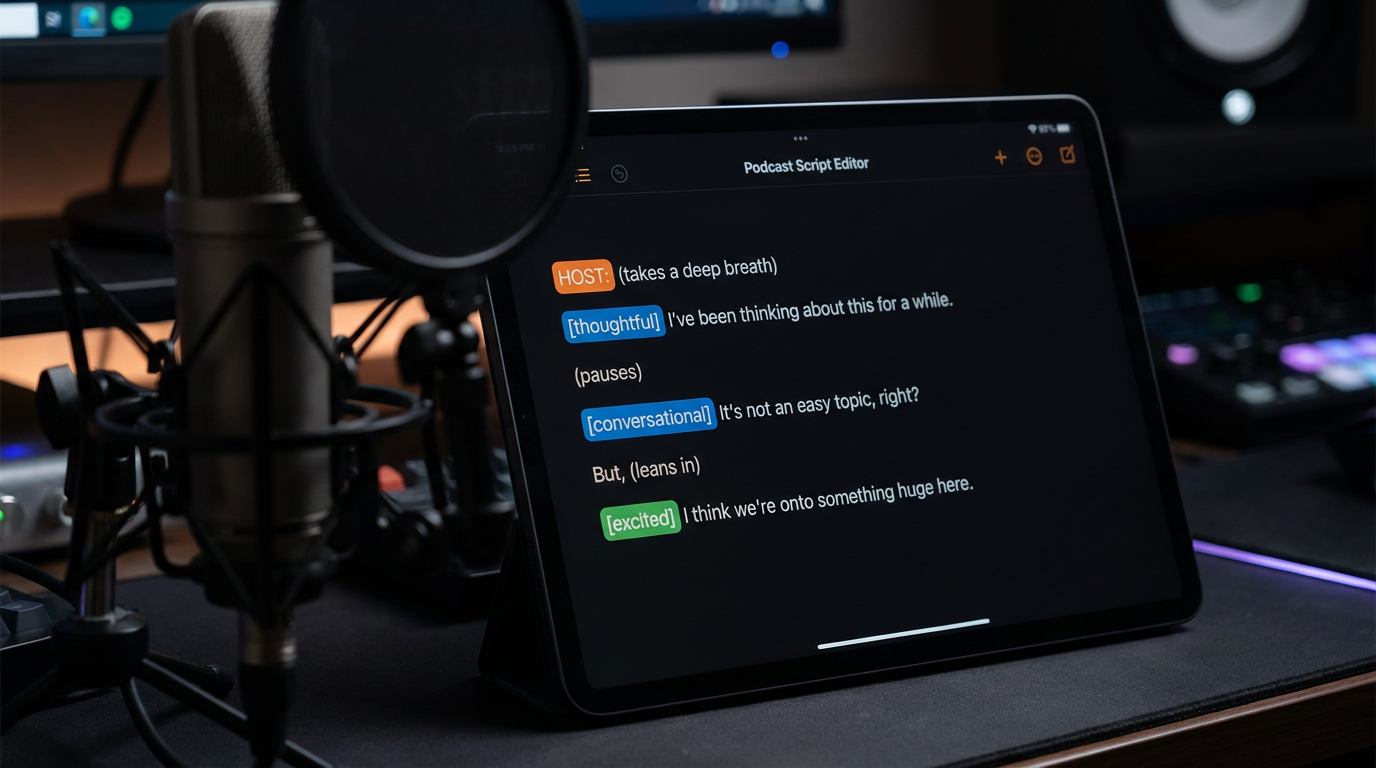
3. Emotional direction brackets steer tone mid-script.
Platforms built on models like the multilingual podcast voice generator in Framia Pro read inline tags as delivery instructions, not text to read aloud.
- [excited] — raises energy, quickens pace
- [thoughtful] — slows cadence, adds space between phrases
- [conversational] — drops formality
- [authoritative] — projects confidence without warmth
- [wry] — adds dry humor
[excited] The results were dramatically better than expected.
[thoughtful] But here's the thing nobody talks about — why they
were better matters as much as the results themselves.
4. Write for the ear, not the eye.
Listeners can't re-read a missed sentence. Prime each concept with a short line before expanding it, and signal transitions out loud: "Now, the counterintuitive part."
5. Callbacks give the model — and the listener — a sense of structure.
Plant a phrase or idea in the intro, then prompt the model to return to it in the outro. It gives the script clear bookmarks, and a good AI voice model captures the tonal arc between the curious open and the resolved close.
The Prompt Checklist: Run This Before You Hit Generate
Before sending any script prompt to your AI podcast generator, check it against this list:
- Format is specified (solo, interview, narrative, briefing, etc.)
- Tone is named explicitly, not implied
- Structure is outlined (hook, segments, close)
- Target length or word count is included
- Emotional direction tags are added at key shifts
- Transition cues are written as phrases, not numbered lists
- Speaker labels are tagged for multi-host scripts
- A callback or closing loop is planned
Missing two or more of these is usually why a first draft sounds flat.
How to Optimize a Prompt After the First Generation
The first output is rarely the final one. Treat it as a diagnostic, not a failure.
If the delivery sounds flat — add more emotional direction brackets and check whether your sentences are too uniform in length. Vary short and long on purpose.
If the pacing feels rushed — add explicit pause cues, commas, em dashes, or a direct instruction like "pause briefly here," and reduce sentence density per segment.
If the tone drifts mid-script — name the tone again partway through the prompt. Long scripts lose the original instruction, and restating it resets the model.
If transitions feel abrupt — add transition phrases directly into the prompt. "Signal each new segment with a spoken transition like 'here's where it gets interesting.'"
If a multi-host script blends voices — re-check speaker labels. Missing or inconsistent labels are the most common cause of voice bleed between hosts.
Regenerate one segment at a time when refining, not the whole episode. It's faster, and it isolates what actually changed.
Common AI Podcast Script Mistakes to Avoid
- Writing for the eye, not the ear — dense paragraphs work in articles, not audio
- No transition signals — listeners need explicit cues
- Overloading one sentence — split complex ideas across several
- Jargon without definition — define it immediately, in plain language
- No emotional direction — leaving tone entirely up to the model
- Inconsistent register — mixing formal and casual without purpose
- No intro hook — opening flat instead of with a question or scenario
- Skipping the outro callback — closing abruptly
- Numbered lists in audio — use "first, next, finally" instead
- Over-scripting spontaneity — tags like [laugh] rarely help; use sparingly

Using Framia Pro to Run These Prompts
Framia Pro's workflow is built around exactly this loop: write the prompt, generate, listen, adjust, regenerate. You can run one script through multiple voice profiles at once and compare delivery side by side, instead of guessing which voice will land before you commit.
For an ongoing series, the platform saves your prompt structure and voice profile for reuse, so episode fifty sounds as consistent as episode one. If you're deciding which model to build a show around, the Eleven v3 voice model review breaks down the expressiveness of the current generation of AI voice in more depth. An AI voice model for podcast scripts built for emotional range makes the prompt techniques above land the way they're meant to.
Write the Prompt Like You're Directing, Not Asking
The creators getting the best results from AI podcasts aren't using secret tools. They're writing better prompts — specifying format, tone, structure, and pacing instead of handing over a bare topic.
Start with the formula. Pick the template that matches your format. Run it against the checklist before you generate. Then optimize the output instead of starting over from scratch.
Ready to put this into practice? Framia Pro gives you a script workflow built around these techniques from episode one.
FAQ
What is an AI podcast script prompt?
An AI podcast script prompt is the instruction you give an AI model to generate a podcast script — specifying format, topic, tone, structure, and pacing. A strong prompt produces a script with natural rhythm and clear direction. A vague one produces flat, generic narration.
How do I make an AI podcast voice sound more natural?
Use punctuation deliberately as a pacing guide, break long sentences into shorter ones for key points, add emotional direction brackets around phrases where you want tonal variation, and signal transitions explicitly so the model knows the energy is shifting.
Can I use my own voice in an AI podcast generator?
Yes — most current AI podcast platforms support voice cloning from a short audio sample, typically 30–60 seconds. The cloned voice can then speak any script text with your characteristic tone, accent, and delivery style.
What length should an AI podcast script be?
A typical ten-minute episode runs approximately 1,400–1,600 words at a natural speaking pace (around 140–160 words per minute). AI voice models tend to deliver slightly faster than human narrators, so add pauses and section breaks to calibrate length.
Do emotional direction prompts always work?
Support varies by platform and voice model. Brackets like [excited] or [thoughtful] are standard on platforms using ElevenLabs v3 and similar models. If your platform doesn't interpret them, remove them before generation — they'll be read aloud otherwise. Generate a short preview first to confirm.