Traditional 3d product photography meant turntables, specialized camera rigs, and post-production stitching that took hours per product. For most small and mid-sized e-commerce sellers, that was simply off the table. AI has changed the economics entirely. This guide covers the most practical use cases for AI-driven 3d product photography — who it is for, what it produces, and where it fits into a modern e-commerce visual workflow.

What AI-Powered 3D Product Photography Actually Delivers
Before exploring use cases, it helps to define what "3d product photography" means in an AI context. Traditional 3D photography captures dozens of sequential frames on a turntable, then stitches them into a spin animation or 3D model. AI 3d product photography takes a different approach: starting from one or a few flat photos, the AI generates multiple calculated viewpoints that simulate the experience of viewing a product in three dimensions.
The outputs vary by platform and use case. Some tools produce interactive spin views — a set of 24 or 36 frames that users can drag to rotate the product. Others generate a curated selection of 4–8 high-quality perspective views covering front, three-quarter, side, and overhead positions. And some produce full 3D mesh models suitable for AR product viewers on Shopify, Amazon, and other platforms.
Framia Pro's Angle Control module falls into the second category: AI-generated perspective views from a single uploaded image. For sellers who need comprehensive angle coverage without a turntable or 3D software, this is the highest-value starting point. Explore Framia Pro's AI product photography angle control to see how it generates consistent multi-angle sets from your existing product photos.
3D Product Photography AI Use Cases for Fashion and Apparel
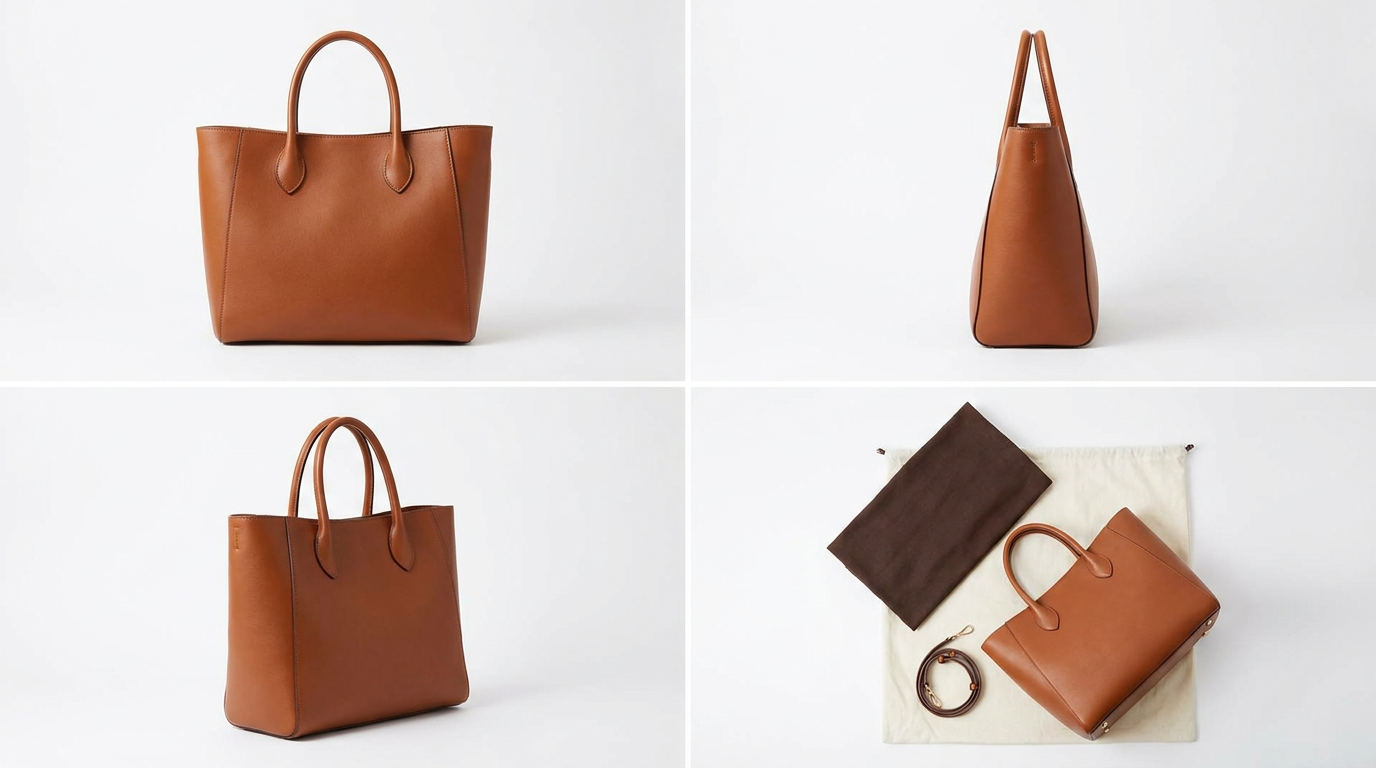
Fashion and apparel are where 3d product photography has the clearest ROI. Clothing and accessories communicate fit, drape, and volume through dimensional views that flat photography cannot capture. AI-generated angle sets make this achievable without a model or mannequin for every shot.
Use case — multi-angle shoe display. Footwear requires at least five angles to show the heel, sole, interior, side profile, and toe box. Framia Pro generates each of these views from a single clean studio shot of the shoe, maintaining consistent lighting and background across the full set. The result matches what a full product photography session would produce in two minutes rather than two hours.
Use case — bag and accessory depth display. Bags lose their silhouette in front-facing flat shots. A three-quarter AI-generated angle shows the bag's depth, strap attachment, and hardware detail simultaneously. For sellers on marketplaces with image limits, this one angle often replaces three separate photos.
Use case — apparel scale context. AI image tools can place garments on simulated body forms at multiple angles, communicating fit without requiring a model booking. This is especially useful for sizing-sensitive categories like fitted tops, tailored trousers, and athletic wear.
For sellers who want a prompt-first approach to angle generation rather than image-upload workflows, our AI product photo prompts guide covers angle-specific prompts for every category including fashion.
3D Product Photography Use Cases for Beauty and Skincare

Beauty is the category that benefits most from close-up angle diversity. A skincare or cosmetics product page that shows only one or two views leaves customers guessing about texture, finish, size, and application detail — all of which drive purchase decisions.
Use case — label legibility angles. Regulatory requirements often dictate that ingredient lists and usage instructions appear on the label. AI 3d product photography generates a rear-facing and side-facing angle that keeps the label in sharp focus — critical for compliance-sensitive categories.
Use case — texture and finish close-ups. Matte versus glossy, powder versus cream, pressed versus loose — these distinctions sell products. AI-generated macro-perspective views highlight surface texture in ways that flat hero shots cannot. Framia Pro's Angle Control handles this by generating close-up viewpoints that crop into the product surface while maintaining lighting fidelity.
Use case — cap-on versus cap-off comparison. For bottles, tubes, and compacts, showing the open and closed states in a coordinated set helps customers understand the product ergonomics. AI generates both states with matched backgrounds and lighting for visual consistency across the full detail set.
Use case — lifestyle overhead for flat-lay bundles. Beauty brands frequently sell curated sets and kits. Overhead AI photography generates a flat-lay view of the bundle that communicates the full product range in a single scannable image — ideal for Instagram ads and homepage banners.
3D Product Photography for Electronics and Hard Goods
Electronics require the highest degree of dimensional accuracy because customers need to assess port placement, button layout, screen dimensions, and cable compatibility before purchasing. AI 3d product photography handles hard goods well because rigid objects do not have the shape variability that makes clothing and soft goods challenging.
Use case — port and connectivity views. A Bluetooth speaker or laptop needs a side-panel view showing every port and connection point. AI generates this angle from the front-facing source image with enough accuracy for informational purposes, even if a manual photo remains best for high-stakes technical products.
Use case — scale comparison context. Hard goods often fail on listings because buyers cannot gauge size. AI can generate a scaled comparison view showing the product alongside a recognizable reference object that establishes physical dimensions without requiring a reshooting session.
Use case — color variant angle sets. If you sell a speaker in six colors, generating a full angle set for each color manually is prohibitively expensive. AI generates the full angle set for each color variant from a single source image per color, eliminating six studio sessions and reducing cost per variant to near zero.
How Framia Pro Supports AI 3D Product Photography Workflows

Framia Pro's Angle Control module is built for sellers who need perspective coverage at catalog scale. The platform accepts a single uploaded product image and generates a complete angle set — front, 45-degree three-quarter, side profile, and overhead — with consistent lighting, shadow behavior, and background treatment across every generated view.
For 3d product photography workflows, Framia Pro excels in three areas. First, batch processing: upload multiple SKUs and queue angle generation for the entire catalog overnight. Second, background locking: the AI preserves or recreates your chosen background across all angle variations, so the full set reads as a cohesive shoot rather than a patchwork of different sessions. Third, resolution output: every generated angle is exported at e-commerce platform resolution — large enough for Amazon zoom, Shopify galleries, and paid social ad formats.
Framia Pro's 3D product photography AI tool is the fastest path from a single product photo to a publish-ready multi-angle set covering every view your listing needs.
For sellers who are new to AI product workflows, the product photography AI tips guide covers the foundational setup steps — base image quality, background strategy, and batch template design — before you commit to a full angle generation run.
FAQ
What is AI 3D product photography?
AI 3d product photography uses machine learning to generate multiple perspective views of a product from a small number of source images — often just one. It simulates the output of a traditional turntable or multi-camera rig without the physical equipment or studio time. The resulting images cover the angle range customers need to feel confident in a purchase decision.
Is AI 3D product photography as accurate as traditional turntable photography?
For most e-commerce use cases, AI-generated angle sets are accurate enough for listing purposes. High-stakes categories — medical devices, precision tools, luxury watches — still benefit from manual photography for their primary hero shots. For secondary angles, color variants, and catalog-scale production, AI offers a strong quality-to-cost trade-off.
Which product categories benefit most from 3D product photography?
Fashion, footwear, beauty, electronics, and furniture see the highest conversion lift from dimensional product imagery. These are categories where fit, form, and scale are major purchase drivers that flat photography fails to communicate fully.
Can AI generate spin animations for product pages?
Some AI platforms generate full 360-degree spin sets (24–36 frames) for interactive product viewers. Framia Pro focuses on high-quality perspective stills — a curated 4–8 angle set — which is the more widely supported format across major e-commerce platforms including Amazon, Shopify, and Etsy.
How many images do I need to start AI 3D product photography?
With Framia Pro's Angle Control, one clean, well-lit source photo is sufficient to generate a complete angle set. The better the source image quality, the more accurate and polished the generated angles will be. A sharp phone photo in good natural light is a perfectly acceptable starting point.
Conclusion
AI 3d product photography has removed the primary barrier to dimensional product imagery for e-commerce sellers: the cost and complexity of physical turntable setups. Whether you sell fashion, beauty, or electronics, AI-generated angle sets give buyers the visual information they need to purchase confidently. Framia Pro's Angle Control makes this achievable at any catalog size — from a single hero SKU to thousands of variants — starting from one uploaded product photo.